Geometric Specularity & Shadow Edge Transfer
An authoritative studio lighting physics dissertation on Light Modifiers. We formulate the Angular Size Law of Shadow Softness (Umbra vs. Penumbra geometry), dissect Double-Diffused Softboxes vs. Octaboxes, analyze True Parabolic Reflectors (Broncolor Para / Briese focusable beam collimation), Beauty Dish deflected contrast, and Honeycomb Louver Grids.
What actually makes light “Hard” or “Soft”? Beginners often believe that putting a piece of white nylon diffusion fabric in front of a flash bulb magically transforms the photons themselves into “soft photons.” In optical physics, there is no such thing as a soft photon! Hardness vs. Softness is strictly a geometric property of the Shadow Edge Transition (the width of the Penumbra between full light and full shadow), and it is governed 100% by a single variable: the Apparent Angular Size (Solid Angle) of the light source relative to the subject!
In this comprehensive studio lighting guide, we examine the ray-tracing geometry of shadow penumbras, explain why a giant 5-foot octabox becomes a hard, crisp light source when moved 25 feet away, and dissect the internal optical mechanics of softboxes, umbrellas, beauty dishes, Fresnel lenses, and true focusable parabolic reflectors.
1. Umbra vs. Penumbra Geometry: Why Apparent Angular Size Rules All
When a light source illuminates a three-dimensional object (such as a portrait model’s nose or cheekbone) casting a shadow onto their cheek, the shadow is divided into two distinct geometric zones:
- The Umbra (Core Shadow): The region completely blocked from seeing any part of the light source.
- The Penumbra (Shadow Transition Gradient): The partial-shadow border zone where the surface sees part of the light source while the rest of the light source is eclipsed by the nose!
The physical width of this Penumbra gradient (W_p)—which our eyes perceive as “softness” or “wrap-around light”—is governed by the ratio of the light source’s physical diameter (D_light) to its distance from the subject (d_light), multiplied by the subject-to-shadow distance (d_shadow):
Penumbra Width (Wp) = dshadow × ( Dlight / dlight ) | Angular Size (θ) = 2 × arctan( Dlight / [ 2 × dlight ] )
The Solar Proof of Angular Size:
The Sun is the largest light source in our solar system—measuring 1.39 million kilometers in diameter! Yet on a clear day, the Sun casts razor-sharp, high-contrast Hard Shadows! Why? Because the Sun sits 150 million kilometers away, reducing its apparent angular size in the sky to a tiny pinpoint of just 0.53 degrees! Conversely, when an overcast cloud layer covers the sky at 1,000 meters altitude, the entire 180-degree hemisphere becomes the light source—wrapping around every facial contour with virtually zero shadow edge!
2. Diffused vs. Specular Reflections: Why Modifier Texture Matters on Skin and Metal
Beyond shadow edge penumbra, light modifiers control a second critical optical dimension: Specular Highlight Density. Every human face (containing natural skin oils), leather shoe, glass bottle, or metallic watch case exhibits both Diffuse Reflection (light absorbed and re-emitted in all directions by skin pigment) and Direct Specular Reflection (mirror-like surface reflection where the Angle of Incidence equals the Angle of Reflection).
- White-Lined Softbox with Double Diffusion Baffles: Spreads light energy evenly from corner to corner across the front nylon panel. The specular reflection on the model’s forehead and bridge of the nose is a soft, uniform satin glow, minimizing skin pores and wrinkles.
- Silver-Lined Modifier (Beauty Dish, Silver Umbrella, Parabolic without Front Diffuser): The faceted metallic silver interior acts like thousands of tiny angled mirrors, concentrating higher-intensity collimated rays toward the center. Even if the silver umbrella has the exact same 60-inch diameter as a white softbox (producing the exact same soft shadow edge penumbra!), the silver interior produces crisp, punchy, high-contrast specular highlights that make skin sheen, cheekbones, and fabric textures pop!
3. Studio Light Modifier Optical Comparison Matrix
The comparative optical geometry, shadow transfer, specular highlight character, and directional control across primary studio modifiers are benchmarked below:
| Light Modifier Type | Internal Optical Geometry | Shadow Edge Penumbra | Specular Highlight Character | Primary Studio Application |
|---|---|---|---|---|
| Bare Flash Tube / Standard 7″ Reflector | Tiny point source (< 18cm); direct collimated rays | Razor-sharp hard shadow edge | Intense pinpoint specular hot-spots | High-contrast fashion, hard sunlight emulation, sports |
| Double-Diffused Octabox (120cm–150cm) | Large Lambertian flat diffusion plane | Wide, buttery-soft penumbra wrap | Smooth, even satin catchlights | Flattering beauty portraiture, commercial lifestyle |
| Beauty Dish (55cm White / Silver + Deflector) | Central deflection plate blocks direct hot-spot; parabolic rim | Crisp medium-soft shadow transfer | Punchy center contrast with smooth roll-off | Editorial fashion, close-up facial sculpture, athletic portraits |
| True Focusable Parabolic (Para 88 / 133 / 222) | 24-rib deep parabolic mirror + focusable lamp rod | Variable (Collimated spot to Flood) | Three-dimensional specular micro-contrast | High-fashion advertising, full-length runway modeling |
| Stripbox (30x140cm) + 40° Honeycomb Grid | Narrow vertical aperture + directional louvers | Soft vertically, rapid horizontal cut | Elongated linear edge highlight | Rim/kicker hair lighting, bottle/glassware contour striping |
| Optical Snoot / Fresnel Spot | Condenser glass lens + focusable front element | Hard cinematic theatrical edge | High-intensity collimated beam | Film-noir dramatic slashes, gobo background patterns |
4. True Parabolic Reflectors vs. Deep Octaboxes: The Optical Myth Exposed
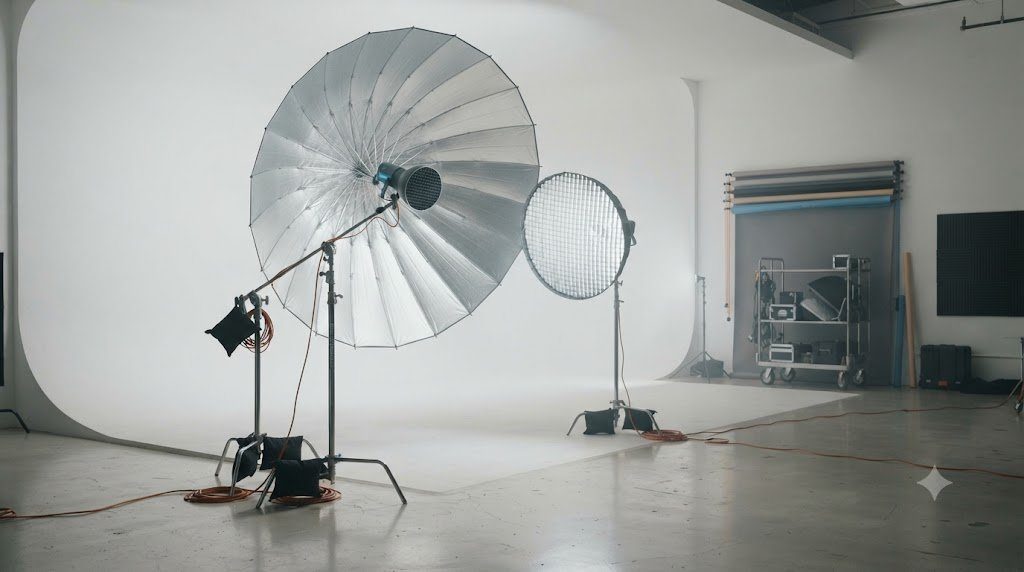
One of the most pervasive marketing myths in modern photography is calling any deep, 16-sided nylon softbox with a front fabric diffuser a “Parabolic Softbox.” Let us state the optical engineering truth unequivocally: the moment you stretch a white nylon diffusion baffle across the front of a deep softbox, you destroy all parabolic ray collimation and convert the modifier into a standard Lambertian flat-panel octabox!
To understand why a true parabolic reflector (such as a Broncolor Para 88 / 133 / 222, Briese Focus, or Profoto Giant) costs $3,500 to $12,000 and produces an unmistakable three-dimensional commercial fashion look, we must examine the geometry of a Parabola (y = x^2 / [4f]):
- 24-Rib Highly Specular Silver Interior (Used WITHOUT Diffusion Fabric): A true parabolic modifier is lined with 24 tensioned segments of mirror-like metallic silver fabric curved into a deep mathematical paraboloid, and it is operated open-faced without any internal or front nylon diffusion baffles.
- The Focusable Central Lamp Rod (Defocus vs. Focus Positions): Instead of mounting the strobe head at the back pointing forward, a true Para mounts the bare flash tube on a telescoping central rod pointing backward into the silver apex!
- Focused Position (Flash Tube at the Exact Parabolic Focal Point
F): Every ray of light striking the 24 silver ribs reflects straight forward parallel to the optical axis as a collimated shaft of light! Despite the modifier measuring 133cm or 222cm across (which creates a huge, wrapping shadow penumbra), the specular rays are parallel—producing crisp, high-microcontrast skin texture and intense catchlights that barely fall off from head to toe on a standing full-length fashion model! - Defocused Position (Flash Tube Pulled Toward the Front Rim): Rays reflect inward and cross over in front of the modifier, spreading into a wide, ultra-soft flood beam with a gentle center-to-edge gradient.
- Intermediate Position (Flash Tube Pushed Deep into the Rear Apex): Rays diverge outward from the outer silver rim while leaving a slightly softer central core, creating a massive, enveloping wrap-around beauty light.
- Focused Position (Flash Tube at the Exact Parabolic Focal Point
5. The Beauty Dish: Deflected Parabolic Contrast for Facial Sculpture
Invented for high-fashion editorial and cosmetic beauty portraiture, the Metal Beauty Dish (typically 42cm to 70cm in diameter) occupies the exact optical sweet spot between a hard bare reflector and a soft diffused octabox. How does its internal geometry create its signature “crisp yet flattering” look?
- The Central Opaque Deflector Plate: Suspended directly in front of the bare flash tube is a small circular metal disc. This disc completely blocks the harsh, direct point-source rays from hitting the model’s face directly—eliminating the harsh pinpoint shadow edge of a bare bulb!
- Double-Bounce Annular Emission: Blocked by the center plate, 100% of the flash tube’s output bounces outward against the curved metallic dish bowl, transforming a 2-inch flash tube into a 22-inch glowing ring of concentrated light with a slightly softer central core.
- White-Interior vs. Silver-Interior Beauty Dishes: A White Beauty Dish scatters the bounced rays diffusely off matte white enamel paint, creating creamy, porcelain skin tones ideal for close-up cosmetic portraits. A Silver Beauty Dish preserves specular ray directionality, punching up cheekbone shadow contrast and dramatic athletic muscle definition. Adding a thin nylon “diffusion sock” over the front rim softens specular sheen by 0.5 stops while preserving the circular ring-like catchlight in the subject’s iris.
6. Directional Control: Honeycomb Grids, Eggcrates, Flags, and Barn Doors
A large softbox or beauty dish emits light across a wide 110-degree to 140-degree hemisphere (Lambertian cosine emission). While wide dispersion is desirable when illuminating a white studio room, it is disastrous when shooting moody low-key portraits, dark food photography, or rim lighting where you want light on the subject’s face without spilling a single photon onto the background 3 feet behind them!
To restrict the angular spread of a soft light source without shrinking its physical surface area (and therefore without making the light harder on the subject!), studio photographers attach Honeycomb Grids (Metal Grids) or Fabric Eggcrate Louvers across the front face of the modifier:
- How a Grid Preserves Softness While Narrowing Beam Angle: A fabric eggcrate consists of hundreds of black cloth cells (typically 5cm × 5cm squares, 5cm deep). For a subject standing directly in front of the gridded octabox, their face still sees the entire 120cm glowing surface through the open cells—so the shadow edge penumbra on their cheek remains 100% soft! However, any oblique ray attempting to exit the softbox sideways toward the background or camera lens strikes the matte-black cell walls and is absorbed!
- Choosing Grid Degree Ratings (10°, 20°, 30°, 40°, 50°):
- 40° – 50° Fabric Eggcrate (Softbox / Octabox Standard): Cuts side spill by ~50% with only a
-0.5 EVcenter light loss, producing a smooth, natural vignette around the subject. - 20° – 30° Metal Honeycomb Grid (Beauty Dish / 7-Inch Reflector): Carves out a tight theatrical spotlight on the model’s face or product with rapid peripheral falloff.
- 10° Ultra-Narrow Spot Grid: Projects a tiny, isolated circle of light across a dark set for selective accent highlighting on eyes, jewelry, or dark bottle labels.
- 40° – 50° Fabric Eggcrate (Softbox / Octabox Standard): Cuts side spill by ~50% with only a
7. Specular Product Lighting: The Family of Angles (F=I) and Scrim Diffusers
When photographing highly reflective objects—such as luxury wristwatches, wine bottles, polished chrome silverware, or glossy cosmetics—softboxes placed in normal portrait positions often fail, showing ugly hard edges of the softbox frame reflected directly in the curved metal or glass surface!
In commercial tabletop photography, reflective surfaces are governed by the Law of Specular Reflection: the Angle of Incidence equals the Angle of Reflection (θ_i = θ_r), defining what lighting textbook authors Hunter, Biver, and Fuqua call the Family of Angles:
- Why Softbox Edges Show Up in Bottles: A wine bottle is a vertical convex cylinder; its curved glass surface sees a nearly 180-degree panorama of the studio room! If you place a standard stripbox 3 feet away from the bottle, the bottle reflects the bright white rectangle of the stripbox surrounded by the harsh black walls of the room.
- The Double-Diffused Scrim Gradient Technique: Instead of lighting the bottle directly with a softbox, commercial product photographers place a massive, seamless 4×4-foot translucent diffusion scrim panel (Lee 216 or Savage Translum) just inches away from the bottle (filling the bottle’s entire Family of Angles). Behind that scrim, they aim a bare strobe with a 20-degree honeycomb grid at one edge of the scrim panel! Because the strobe hits the scrim obliquely, it creates a flawless, continuous luminance gradient from bright white to soft gray across the scrim—which reflects in the curved glass bottle as a seamless, three-dimensional luxury highlight with zero hard edges!
Umbrella Modifiers: Shoot-Through Translucent vs. Reflective White vs. Silver
While octaboxes and beauty dishes dominate permanent studio spaces, the humble Photographic Umbrella remains the fastest, highest-output portable light modifier ever engineered. However, the three distinct umbrella architectures exhibit dramatically different Inverse-Square falloff and specular behavior:
- Shoot-Through Translucent White Umbrella: Aimed directly at the subject like an open-backed softbox. Because 50% of the flash tube’s light passes forward through the white nylon canopy while the other 50% bounces backward into the room ceiling and walls, shoot-through umbrellas create a massive ambient bounce fill that lifts room shadows—ideal for cramped dark interiors, but terrible when you want controlled low-key black backgrounds!
- Reflective Black-Backed White Umbrella: The strobe faces backward into a matte-white concave canopy lined with an opaque black exterior backing. It prevents rear room spill while delivering broad, forgiving, low-specularity wrap-around illumination ideal for corporate headshots and family groups.
- Deep Parabolic Silver Umbrella + Front Diffuser Sock: Combines the high photon efficiency (+0.8 EV brighter than a double-baffled softbox) and rapid 15-second setup of an umbrella with the round catchlights and controlled forward throw of a deep octabox.
Studio Modifier Selection Rule of Thumb
1. Softness is controlled by Size-to-Distance Ratio: A 120cm octabox at 1 meter is ultra-soft; that same 120cm octabox at 6 meters is hard!
2. Contrast & Specularity are controlled by Interior Material: White interior + double baffle = low specular contrast (hides skin texture); Silver interior / Beauty Dish = high specular micro-contrast (enhances skin sheen & cheekbones).
3. Spill is controlled by Grids: A grid does NOT make light harder on the subject at the center of the beam—it only blocks off-axis spill onto the background!