Geometrical & Wave Optics Engineering
An exhaustive optical engineering dissertation dissecting Ludwig von Seidel’s Five Monochromatic Aberrations alongside Longitudinal and Lateral Chromatic Aberration. We analyze Abbe Number dispersion (V_d), Extra-Low Dispersion (ED/UD) Fluorite glass, Apochromatic (APO) 3-wavelength correction, Precision Molded Aspherical elements, and Sub-Wavelength Nano AR Coatings.
A simple single-element convex glass lens (a magnifying glass) is fundamentally incapable of producing a sharp, high-contrast, color-accurate photographic image. Because light waves refract according to Snell’s Law (n_1 × sin(θ_1) = n_2 × sin(θ_2)) and because the refractive index n of optical glass varies continuously with the wavelength of light, a simple spherical lens suffers from severe geometrical and chromatic defects known as Optical Aberrations.
To focus light from a three-dimensional scene onto a flat 60-megapixel silicon sensor with sub-4-micron precision from corner to corner even wide open at f/1.2 or f/1.4, modern optical engineers combine 15 to 23 individual glass elements made of exotic anomalous-dispersion fluorite crystals, precision-molded non-spherical surfaces, and nanostructured anti-reflective coatings. In this comprehensive treatise, we dissect every optical aberration and the glass technologies engineered to conquer them.
1. Chromatic Aberration (CA): Dispersion, Abbe Numbers, and APO Correction
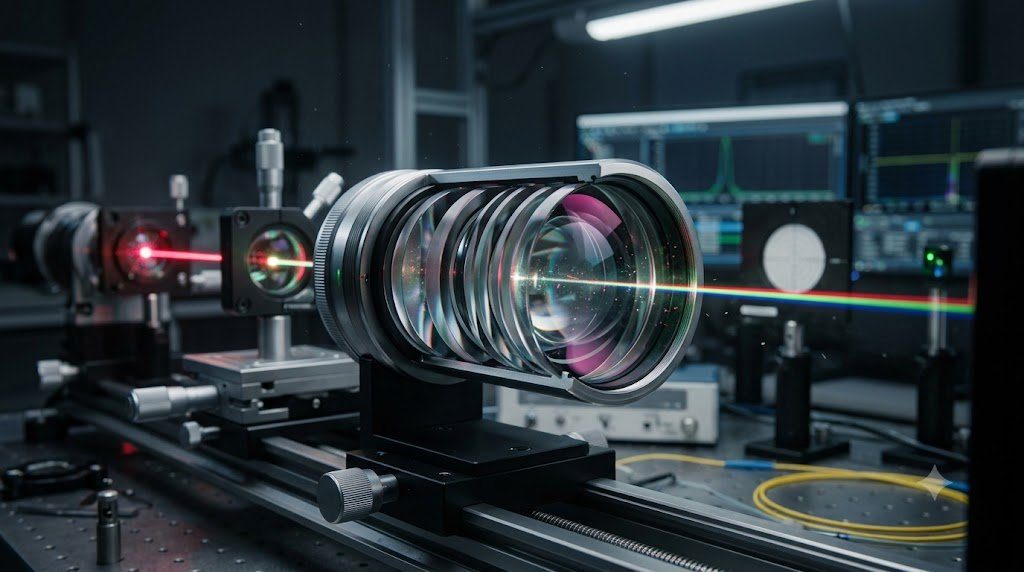
When white light passes through crown or flint optical glass, shorter wavelengths (400nm–450nm violet/blue light) experience a higher refractive index and bend more sharply than longer wavelengths (620nm–700nm red light)—the exact same dispersion physics that causes a prism to split sunlight into a rainbow. In a camera lens, this wavelength-dependent refraction is quantified by the glass material’s Abbe Number (V_d):
Abbe Number (Vd) = ( nd – 1 ) / ( nF – nC )
Where n_d, n_F, and n_C are the refractive indices of the glass at the Fraunhofer yellow Helium line (587.6nm), blue Hydrogen line (486.1nm), and red Hydrogen line (656.3nm). High Abbe numbers (V_d > 60 to 95) indicate ultra-low color dispersion. Chromatic aberration manifests in two distinct forms:
- 1. Longitudinal (Axial) Chromatic Aberration (LoCA / ‘Bokeh Fringing’): Occurs along the optical axis across the entire frame at wide apertures (f/1.2–f/2.0). Blue wavelengths focus slightly in front of the sensor plane, while red wavelengths focus behind it. Out-of-focus foreground highlights exhibit magenta/purple halos, while background highlights behind the focal plane exhibit green halos! LoCA shrinks when stopping down the aperture, but is difficult to remove fully in software.
- 2. Lateral (Transverse) Chromatic Aberration (LaCA): Occurs exclusively toward the outer corners of the frame because the lens magnifies red, green, and blue images to slightly different physical sizes. High-contrast edges near the frame borders show cyan/blue fringing on one side and red/yellow fringing on the opposite side. Unlike LoCA, Lateral CA does not improve when stopping down the aperture, making 1-click radial scaling in raw software the ideal fix.
Achromatic vs. Apochromatic (APO) Lens Designs:
An Achromatic Doublet pairs a convex crown glass element with a concave flint glass element to bring two wavelengths (typically Red and Blue) to the exact same focal plane. A true Apochromatic (APO) lens (such as the Voigtländer APO-Lanthar, Leica APO-Summicron, or Sigma Art series) incorporates Extra-Low Dispersion (ED / UD / SLD) or synthetic Calcium Fluorite (CaF₂, V_d = 95.0) crystals with anomalous partial dispersion to bring three wavelengths (Red, Green, and Blue) to the exact same focal point—virtually eliminating both Longitudinal and Lateral color fringing even wide open!
2. Seidel’s Five Monochromatic Aberrations: Spherical, Coma, Astigmatism, Curvature, and Distortion
Even if you photograph a scene under purely monochromatic laser light of a single wavelength (where Chromatic Aberration is zero), spherical glass lenses still suffer from five geometric optical defects codified by German mathematician Philipp Ludwig von Seidel in 1856:
- 1. Spherical Aberration (SA): Because the surface of a conventional lens is ground as a sphere, marginal light rays striking the outer perimeter of the glass bend more steeply and focus closer to the lens than paraxial rays passing through the center. This wraps sharp details in a dreamy, low-contrast glowing haze wide open and causes Focus Shift when stopping down from f/1.4 to f/2.8! Corrected via Aspherical Elements whose curvature flattens progressively toward the perimeter.
- 2. Coma (Comatic Aberration): Off-axis point light sources (such as stars in the corners of a nightscape frame) are smeared into asymmetric, V-shaped winged flares resembling flying comets or seagulls! Because coma is fatal to astrophotography, nightscape lenses rely on large-diameter precision-molded front aspherical elements to achieve flat sagittal coma performance at f/1.4.
- 3. Astigmatism: Off-axis light rays oriented tangentially (Meridional / Tangential plane, running concentrically around the optical center) focus at a different distance than rays oriented radially (Sagittal plane, radiating outward like wheel spokes). A point source smears into a short line in one direction in front of focus, and a perpendicular line behind focus.
- 4. Petzval Field Curvature: A natural optical lens wants to project its sharp focus onto a curved bowl-shaped sphere (the Petzval surface) rather than a flat digital sensor! If a lens has uncorrected field curvature, focusing on a flat brick wall in the center leaves the corners blurry until stopped down, or requires focusing partway toward the edge.
- 5. Geometric Distortion (Barrel, Pincushion, and Mustache): Occurs when magnification varies with distance from the optical axis. Wide-angle retrofocus lenses typically exhibit Barrel Distortion (straight lines bow outward near edges), while telephoto lenses exhibit Pincushion Distortion (lines bow inward).
3. Optical Aberrations Diagnostic & Remediation Matrix
The comprehensive diagnostic reference mapping each optical aberration to its visual symptom, effect of stopping down the aperture, optical glass solution, and software correctability is presented below:
| Optical Aberration | Visual Symptom in Photograph | Effect of Stopping Down Aperture | Optical Engineering Solution | Post-Processing Correctability |
|---|---|---|---|---|
| Longitudinal CA (LoCA) | Magenta fringes in front of focus; green fringes behind focus | Improves significantly when stopped down (f/4–f/5.6) | APO design, Fluorite (CaF2), ED/UD glass | Hard to fix fully; requires defringe brushes |
| Lateral CA (LaCA) | Cyan/Red color fringes along high-contrast corner edges | Does NOT improve when stopping down | Symmetrical rear group & ED elements | 100% auto-corrected in 1 click in Raw software |
| Spherical Aberration | Soft glowing veiling haze across entire frame wide open; focus shift | Disappears rapidly by f/2.8–f/4.0 | Precision Aspherical (XA/ASP) elements | Cannot be fixed properly without losing detail |
| Sagittal Coma | Corner stars smear into winged comets / seagulls at night | Improves when stopped down to f/2.8–f/4 | Large front Aspherical elements | Uncorrectable in standard raw converters |
| Petzval Field Curvature | Center is sharp while corners are out of focus on flat subjects | Masked by deeper Depth of Field at f/8–f/11 | Flat-field optical groups / field flatteners | Uncorrectable in post-processing |
| Barrel / Pincushion Distortion | Straight architectural lines curve outward or inward | Zero change when stopping down | Aspherical & symmetrical lens design | 100% correctable via lens profile (slight edge crop) |
4. Precision Glass Manufacturing: Extreme Aspherical (XA) Grinding vs. Glass Molding
To eliminate spherical aberration and sagittal coma without adding ten extra heavy spherical glass elements, optical engineers utilize Aspherical Lens Elements—elements whose surface radius of curvature changes continuously from the optical axis to the outer edge according to a complex polynomial equation.
Historically, grinding and polishing a single aspherical element by hand (such as on the legendary 1966 Leica Noctilux 50mm f/1.2) required days of master-optician labor and had a 90% rejection rate. Today, camera manufacturers fabricate aspherical elements via three methods—and the surface finish accuracy determines whether your out-of-focus bokeh balls look creamy smooth or suffer from ugly concentric ‘Onion-Ring’ Bokeh!
- 1. Hybrid Aspherical Elements (Budget Lenses): A thin layer of optical UV-curable polymer resin is molded onto a standard spherical glass substrate. Prone to lower thermal stability and internal light scatter.
- 2. Precision Glass Molded (PGM) Aspherical Elements: Heated optical glass preforms are pressed inside a computer-numerical-control (CNC) machined tungsten-carbide mold. If the diamond turning bit used to carve the mold leaves microscopic concentric ridges
0.1 micronsdeep, those ridges imprint onto the glass and appear as ugly concentric “onion rings” inside every out-of-focus highlight circle! - 3. Extreme Aspherical (XA) / Sub-Nanometer Polished Elements (Sony G Master, Nikon S-Line, Canon L): By polishing the mold and glass surface down to a surface roughness tolerance of 0.01 micrometers (10 nanometers), modern flagship lenses eliminate onion-ring bokeh patterns completely while delivering edge-to-edge sharpness at f/1.2!
5. Sub-Wavelength Anti-Reflective Coatings: Nano AR, Meso-Amorphous, and Fluorine
When light passes from air (n = 1.00) into high-index lanthanum flint glass (n = 1.85), Fresnel’s Equations dictate that roughly 4% to 8.9% of the incident light is reflected backward at every single air-to-glass surface! In a modern 20-element zoom lens with 30 air-to-glass surfaces, an uncoated lens would lose over 75% of all incoming light to internal reflections—reducing the image to a washed-out, flare-ridden ghost!
1. Thin-Film Destructive Interference (Quarter-Wave Coatings):
Invented by Alexander Smakula at Carl Zeiss in 1935, vapor-deposited magnesium fluoride (MgF₂) coatings are applied at an exact thickness of one-quarter wavelength (λ / 4). Light reflecting off the top of the coating and light reflecting off the glass interface below emerge 180 degrees out of phase, canceling each other out via destructive wave interference and transmitting the energy forward through the lens!
2. Sub-Wavelength Nanostructured Coatings (Canon SWC/ASC, Nikon Nano Crystal/Meso-Amorphous, Sony Nano AR II):
Traditional vapor-deposited multi-coatings break down when light strikes a steeply curved front element at oblique angles. Modern flagship lenses grow microscopic wedge-shaped silica cones or porous amorphous nanoparticles smaller than the wavelength of visible light (< 200nm) directly onto the glass surface. Because there is no sudden refractive boundary between air and glass—instead, the refractive index transitions smoothly from 1.00 to 1.50—surface reflections drop below 0.05%, eliminating ghosting and veiling flare even when shooting directly into the sun!
6. Diffractive Optics (DO) and Phase Fresnel (PF) Super-Telephoto Engineering
In normal refractive glass, blue light bends more than red light. However, in a microscopic Diffractive Optical Grating (Fresnel Zone Plate), the exact opposite occurs: red light bends MORE than blue light! By bonding a microscopic Phase Fresnel (PF) or Diffractive Optic (DO) grating onto a refractive lens element (such as in the Nikon 500mm f/5.6 PF, 800mm f/6.3 PF, and Canon DO lenses), the reverse chromatic dispersion of the Fresnel grating cancels out the chromatic aberration of the glass instantly—allowing engineers to slash the physical length and weight of an 800mm wildlife super-telephoto lens by 50% (over 2.3 kilograms lighter) so it can be shot handheld all day!
7. Optical Vignetting (Cat’s-Eye Bokeh) vs. Pixel Vignetting
Why do circular out-of-focus bokeh highlights in the center of a fast f/1.2 or f/1.4 lens turn into pointed football or lemon shapes (Cat’s-Eye Bokeh) toward the edges of the frame? Because of Mechanical / Optical Barrel Vignetting! When looking into a fast lens from an off-axis corner angle, the front metal filter ring and rear mount baffle physically eclipse one another, turning the circular entrance pupil into a pointed Venn-diagram almond shape. Stopping the lens down by 1 to 2 stops (e.g., from f/1.4 to f/2.0 or f/2.8) makes the internal circular aperture iris smaller than the outer barrel obstruction, restoring perfectly round bokeh circles across the entire frame and eliminating corner light falloff.
8. Focus Shift Upon Stopping Down: How Spherical Aberration Fools Autofocus
One of the most insidious optical traps when shooting ultra-fast primes (such as 50mm f/1.2 or 85mm f/1.4 lenses that retain residual spherical aberration for dreamy bokeh) is Residual Spherical Aberration Focus Shift.
The Optical Mechanics of Focus Shift:
When a lens suffers from positive spherical aberration, light rays passing through the outer edges of the lens focus slightly in front of the paraxial rays passing through the center of the lens. If you focus the camera at f/1.4, the autofocus system locks onto the focal plane created by the dominant outer marginal rays. However, if you set your camera aperture to f/2.8 or f/4.0 and the camera focuses with the aperture wide open at f/1.4 before stopping the iris blades down at the instant of exposure, stopping down blocks those outer marginal rays—leaving only the inner paraxial rays whose focal plane sits several millimeters behind the subject’s eyes! You aim at the eyelashes, and the ears come out sharp while the eyes are blurry!
How Modern Mirrorless Cameras Prevent Focus Shift:
Unlike DSLRs, which were forced to focus wide open because their phase-detect AF modules went blind past f/5.6, modern mirrorless cameras (Sony, Nikon, Canon) perform Stopped-Down Live-View Autofocus right at the shooting aperture (up to f/5.6 or f/8.0). Because the sensor focuses using the exact same cone of rays that will record the photograph, focus shift is 100% neutralized!
9. Purple Fringing vs. Blooming vs. True Chromatic Aberration:
Photographers frequently confuse three distinct phenomena that create purple or magenta halos around bright tree branches against a bright sky:
- True Longitudinal Chromatic Aberration: Optical dispersion inside the glass elements; shows magenta in front of focus and green behind focus.
- Near-UV / Violet Cortical Scatter (‘Purple Fringing’): Short-wavelength 390nm–420nm violet light scatters across steep air-to-glass interfaces and microlens edges around blown-out specular highlights.
- Sensor Charge Blooming (Historical CCDs): Overflowing electrons spilling into adjacent pixel wells. Eliminated in modern CMOS sensors via vertical anti-blooming drains, though demosaicing interpolation across clipped white edges can still create 2-pixel magenta halos unless Raw Highlight Reconstruction is enabled.