Optical Equivalence & Format Geometry
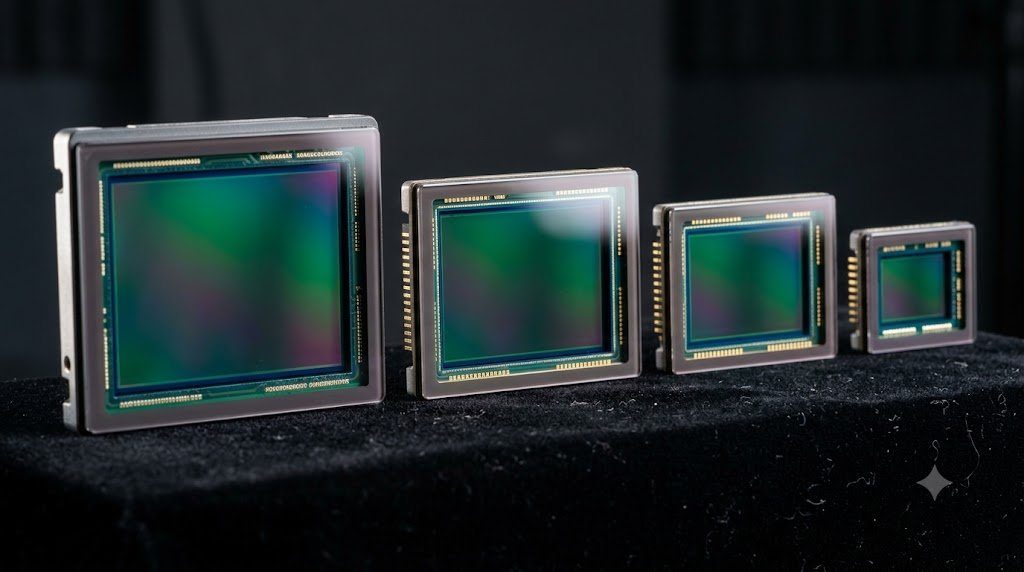
An authoritative optical engineering treatise comparing Medium Format (44x33mm and 54x40mm), 35mm Full-Frame (36x24mm), APS-C (23.5×15.6mm), and Micro Four Thirds (17.3x13mm) sensor geometries. We formulate Crop Factor mathematics, Total Light Gathering (Etendue), Depth of Field equivalence, Diffraction Airy Disk limits, and Signal-to-Noise scaling.
Few subjects in photography generate more confusion, tribal debate, and mathematical misunderstanding than Sensor Format Size and Optical Equivalence. Whether evaluating a 100-megapixel Medium Format system (Hasselblad X2D / Fujifilm GFX 100 II), a 35mm Full-Frame workhorse, an APS-C wildlife body, or an ultra-compact Micro Four Thirds kit, the physical surface area of the image sensor governs the fundamental laws of light capture, field of view, depth of field, and diffraction limits.
In this comprehensive engineering analysis, we strip away marketing myths and establish the exact mathematical equations governing how sensor dimensions interact with optical focal lengths, entrance pupils, and photon shot noise.
1. Physical Sensor Geometries, Surface Areas, and Crop Factors
Historically standardized around Oskar Barnack’s 35mm cinema film frame (36mm × 24mm), digital imaging formats are classified by their physical silicon dimensions and their Diagonal Crop Factor relative to Full-Frame.
The Crop Factor (CF) of any sensor format is defined mathematically as the ratio of the 35mm Full-Frame diagonal (43.27mm) to the diagonal of the target sensor:
Crop Factor (CF) = 43.27 mm / √( Width2 + Height2 )
While photographers routinely use crop factor to calculate equivalent field of view, it is the Total Surface Area that dictates total photon collection capacity:
| Sensor Format Standard | Physical Dimensions | Surface Area | Diagonal Length | Crop Factor (35mm Eq.) | Representative Camera Systems |
|---|---|---|---|---|---|
| Full-Frame 645 Medium Format | 53.4 x 40.0 mm | 2,136 mm² | 66.7 mm | 0.64x | Phase One IQ4 150MP |
| Crop Digital Medium Format (44×33) | 43.8 x 32.9 mm | 1,441 mm² | 54.8 mm | 0.79x | Fujifilm GFX 100 II, Hasselblad X2D |
| 35mm Full-Frame (FX) | 36.0 x 24.0 mm | 864 mm² | 43.3 mm | 1.00x (Baseline) | Sony a7R V, Canon R5, Nikon Z8 |
| APS-C (Sony / Nikon / Fuji DX) | 23.5 x 15.6 mm | 366 mm² | 28.2 mm | 1.53x | Fujifilm X-T5, Sony a6700, Nikon Z50 |
| APS-C (Canon RF-S) | 22.3 x 14.9 mm | 332 mm² | 26.8 mm | 1.61x | Canon EOS R7, EOS R10 |
| Micro Four Thirds (MFT) | 17.3 x 13.0 mm | 225 mm² | 21.6 mm | 2.00x | OM System OM-1, Panasonic GH7 |
| 1-Inch Type Sensor | 13.2 x 8.8 mm | 116 mm² | 15.9 mm | 2.72x | Sony RX100 VII, high-end smartphones |
2. The Physics of Optical Equivalence: Focal Length, Aperture, and ISO
One of the most persistent misconceptions in photography is the statement: “An f/2.8 lens on Micro Four Thirds is identical to an f/2.8 lens on Full-Frame because f/2.8 lets in the same light intensity.” While it is true that the Illuminance (photons per square millimeter) striking the sensor surface is identical at f/2.8, a Full-Frame sensor has nearly 4x the surface area (864 mm² vs 225 mm²) of a Micro Four Thirds sensor!
Therefore, at the same f-number and shutter speed, the Full-Frame sensor collects 3.84x more total photons across the entire image frame. Because image quality and Signal-to-Noise Ratio (SNR) are governed by the total number of photons collected across the entire picture, we must apply Optical Equivalence:
- Equivalent Focal Length:
f_eq = f_actual × CF(Governs identical angle of view and perspective framing). - Equivalent Aperture (Entrance Pupil):
N_eq = N_actual × CF(Governs identical depth of field, diffraction blur, and total light gathered). - Equivalent ISO Sensitivity:
ISO_eq = ISO_actual × CF^2(Reflects identical photon shot noise across the normalized output print).
Real-World Equivalence Example:
A 25mm f/1.4 lens at ISO 100 on a Micro Four Thirds camera (2.0x crop factor) produces the exact same angle of view, depth of field, background bokeh blur diameter, diffraction limit, and total photon noise as a 50mm f/2.8 lens at ISO 400 on a Full-Frame camera! Both lenses share an identical physical entrance pupil diameter of 17.85mm (25/1.4 = 50/2.8 = 17.85mm).
3. Depth of Field and Circle of Confusion Mathematics
Why do larger sensors produce shallower depth of field when framed identically at the same f-stop? To achieve the same framing on a Full-Frame sensor as on an APS-C sensor from the same camera-to-subject distance, the photographer must mount a lens that is 1.5x longer in focal length (e.g., 85mm instead of 56mm).
In optical geometry, Depth of Field (DoF) for a subject at distance s is approximated by:
DoF ≈ ( 2 × N × c × s2 ) / f2
Where N is the aperture f-number, c is the acceptable Circle of Confusion (proportional to sensor size), and f is focal length. Because focal length f is squared in the denominator while the Circle of Confusion c scales only linearly in the numerator, increasing sensor size by 1.5x reduces depth of field by a factor of 1.5x (approx. 1.2 stops) at the same f-number!
4. Diffraction Physics and the Airy Disk Limit Across Formats
While stopping a lens down to f/11, f/16, or f/22 increases depth of field, it simultaneously triggers an inescapable law of wave optics: Optical Diffraction. When light waves pass through a small circular aperture opening, they interact with the aperture blades and bend outward, forming a concentric interference pattern on the sensor plane known as an Airy Disk.
The physical diameter of the central Airy Disk (between its first dark minima rings) is governed strictly by the light wavelength (λ) and the lens aperture f-number (N):
Airy Disk Diameter (dAiry) = 2.44 × λ × N
For green light (λ = 0.00055 mm), the physical size of the Airy Disk at a given f-stop is identical regardless of whether the lens is mounted on a Medium Format camera or a Micro Four Thirds camera:
- At f/4.0: Airy Disk diameter =
5.37 μm - At f/8.0: Airy Disk diameter =
10.74 μm - At f/11.0: Airy Disk diameter =
14.76 μm - At f/16.0: Airy Disk diameter =
21.47 μm
Why Smaller Sensors Hit Diffraction Earlier:
Because a Micro Four Thirds sensor (17.3 × 13mm) must be enlarged 2x more linearly than a Full-Frame sensor (36 × 24mm) to produce the same 24 × 36-inch gallery print, any Airy Disk blur on the MFT sensor is also magnified 2x more! Consequently, f/8 on Micro Four Thirds exhibits the exact same print-level diffraction softening as f/16 on Full-Frame, and f/11 on APS-C matches f/16 on Full-Frame.
5. Pixel Pitch vs. Total Sensor Area: Debunking the ‘Large Pixel’ Myth
One of the most widespread fallacies in digital photography is the claim that “Lower megapixel sensors with larger pixels have better low-light performance than high-megapixel sensors of the same physical format size.”
When comparing a 24-megapixel Full-Frame sensor (5.94μm pixels) against a 61-megapixel Full-Frame sensor (3.76μm pixels) at the Pixel Level (100% zoom on a monitor), an individual 5.94μm pixel certainly has 2.5x the surface area of a 3.76μm pixel and collects 2.5x more photons per pixel. However, we do not view single pixels—we view complete photographs!
When both images are downsampled or printed at the Same Output Size (e.g., an 8K display or a 20 × 30-inch print):
- Total Photon Capture is Identical: Both Full-Frame sensors have an identical physical surface area of
864 mm²and collect the exact same total number of photons from the lens. - Spatial Noise Averaging (Binning): Downsampling 61 million noisy small pixels into a 24-megapixel output image mathematically averages the uncorrelated random shot noise across every 2.5 pixels by
√2.5—completely canceling out the per-pixel noise disadvantage while retaining superior fine-detail acutance and lower color moire!
6. Etendue and the Optical Speed Limit of Lens Design
If optical equivalence allows a smaller sensor to match a larger sensor simply by opening the aperture by the crop factor, why can’t a Micro Four Thirds camera always match a Medium Format camera? Because of the physical optical limit known as Conservation of Etendue (Throughput) and the theoretical limit of refractive lens design in air (roughly f/0.5, and practically f/0.95 to f/1.2).
Suppose a portrait photographer shoots a Full-Frame camera with an 85mm f/1.2 lens at ISO 64:
- To replicate that exact shallow depth of field and light collection on an APS-C camera (1.5x crop), the photographer would need a 56mm f/0.8 lens at ISO 28.
- To replicate it on a Micro Four Thirds camera (2.0x crop), the photographer would need a 42.5mm f/0.6 lens at ISO 16!
Because f/0.6 autofocus photographic lenses and ISO 16 native APS-C/MFT sensors do not exist in practical production, larger sensor formats possess an insurmountable performance envelope at the extremes of shallow depth of field and ultra-low-ISO base dynamic range.
7. Format Selection Matrix by Photographic Genre
Conversely, when deep depth of field is mandatory (such as macro entomology, handheld landscape photography, or birding where every feather must be sharp), larger sensors carry no light-gathering advantage because they must be stopped down to narrow apertures (f/11–f/16) to match the depth of field that a smaller sensor achieves at f/5.6!
| Photographic Discipline | Optimal Sensor Format | Primary Optical & Ergonomic Rationale |
|---|---|---|
| Commercial Studio, Architecture & Fine Art | Medium Format (44×33 / 54x40mm) | 100MP–150MP resolution, 16-bit color depth, 15+ EV dynamic range at ISO 64–80 |
| Weddings, Events, Astrophotography & Portraits | 35mm Full-Frame (36x24mm) | Optimal balance of f/1.2–f/1.4 shallow DoF, extreme high-ISO cleanliness, and fast autofocus |
| Street, Travel, Documentary & Wildlife | APS-C (23.5×15.6mm) | Compact lens weight, 1.5x telephoto reach density, tactile ergonomics |
| Macro, Backcountry Hiking & Birding | Micro Four Thirds (17.3x13mm) | 2.0x telephoto reach, deep native DoF for macro, class-leading IBIS stabilization |
8. Telephoto Reach and Pixel Density Mechanics
In wildlife and avian photography, photographers are frequently “focal-length limited”—meaning they cannot physically walk closer to a nesting eagle and are already using the longest telephoto lens they can carry (e.g., a 600mm f/4). When focal-length limited, image detail on the bird is governed not by total sensor size, but by Pixel Density (Pixels per Square Millimeter)!
An APS-C Canon EOS R7 (32.5MP on 332 mm² = 97,800 pixels/mm²) or a Micro Four Thirds OM-1 (20MP on 225 mm² = 88,800 pixels/mm²) puts nearly 3x more pixels directly on the bird than a 24MP Full-Frame sensor (24MP on 864 mm² = 27,700 pixels/mm²) through the exact same 600mm lens! Mastering sensor format physics empowers photographers to select the precise tool that maximizes optical performance for their specific creative mission.
9. Sensor Readout Heat Dissipation, IBIS Mass, and Mechanical Shutter Physics Across Formats
Beyond pure optical geometry, physical sensor format dimensions dictate profound mechanical and thermodynamic engineering constraints inside the camera body:
1. In-Body Image Stabilization (IBIS) Moving Mass and Excursion Limits:
An IBIS mechanism floats the image sensor on a magnetic levitation stage controlled by electromagnetic voice coils, shifting the sensor across 5 axes (X, Y, Pitch, Yaw, and Roll) to counteract hand tremor. Because kinetic energy scales linearly with mass and quadratically with velocity, stabilizing a massive Medium Format sensor (1,441 mm² silicon + glass filter stack) requires exponentially stronger magnetic actuators and wider physical clearance inside the lens mount throat than stabilizing a featherweight Micro Four Thirds sensor (225 mm²).
This mechanical physics explains why Micro Four Thirds cameras (such as the OM System OM-1) achieve up to 8.5 stops of CIPA stabilization—enabling multi-second handheld exposures of waterfalls—whereas Medium Format systems must work much harder to counter high-frequency angular vibrations.
2. Mechanical Focal-Plane Shutter Blade Travel Distance:
A vertical-travel focal-plane shutter moves its curtains across the short vertical height of the sensor:
- Micro Four Thirds Vertical Travel:
13.0 mm - APS-C Vertical Travel:
15.6 mm - 35mm Full-Frame Vertical Travel:
24.0 mm - Medium Format (44×33) Vertical Travel:
32.9 mm
Because shutter curtains on a Medium Format sensor must travel 2.5x farther than on Micro Four Thirds, maximum mechanical flash sync speed on focal-plane Medium Format bodies is physically restricted to 1/125s, whereas Full-Frame and APS-C bodies achieve 1/250s to 1/400s! To overcome this mechanical speed barrier in commercial studio flash work, Medium Format photographers rely on Central Leaf Shutter Lenses (such as Hasselblad XCD lenses), which position the shutter blades inside the lens aperture iris to sync at up to 1/2000s or 1/4000s.
10. Aspect Ratio Geometry: 3:2 vs. 4:3 vs. 16:9 Sensor Utilization
An often-overlooked variable when comparing sensor formats is Native Aspect Ratio. While 35mm Full-Frame and APS-C sensors inherit the elongated 3:2 aspect ratio (1.50:1) of 35mm cinema film, both Digital Medium Format (44 × 33mm and 54 × 40mm) and Micro Four Thirds (17.3 × 13mm) utilize the squarer 4:3 aspect ratio (1.33:1).
Why does aspect ratio matter in commercial print and editorial production? Standard editorial magazine pages, 8 × 10-inch portrait frames, 16 × 20-inch fine-art gallery prints, and vertical social media placements are much closer to 4:3 or 4:5 than 3:2! When a Full-Frame 3:2 sensor is cropped to an 8 × 10 (4:5) vertical portrait, you throw away 16.7% of your horizontal sensor width and megapixels (cropping 36 × 24mm down to 30 × 24mm = 720 mm²). A 4:3 sensor wastes only 6.25% of its area when cropped to 4:5, preserving maximum vertical silicon utilization and optical field of view.
Comprehensive Format Decision Summary:
Ultimately, no single sensor format is universally superior across all laws of physics. Medium Format reigns supreme in deliberate tripod and studio environments where 16-bit tonal transitions and 100-megapixel micro-detail define the craft. Full-Frame stands as the versatile apex for event, portrait, and low-light photojournalism. APS-C and Micro Four Thirds excel where portability, deep depth of field, high pixel density on distant wildlife, and unmatched IBIS agility empower the photographer to capture fleeting moments in the field.